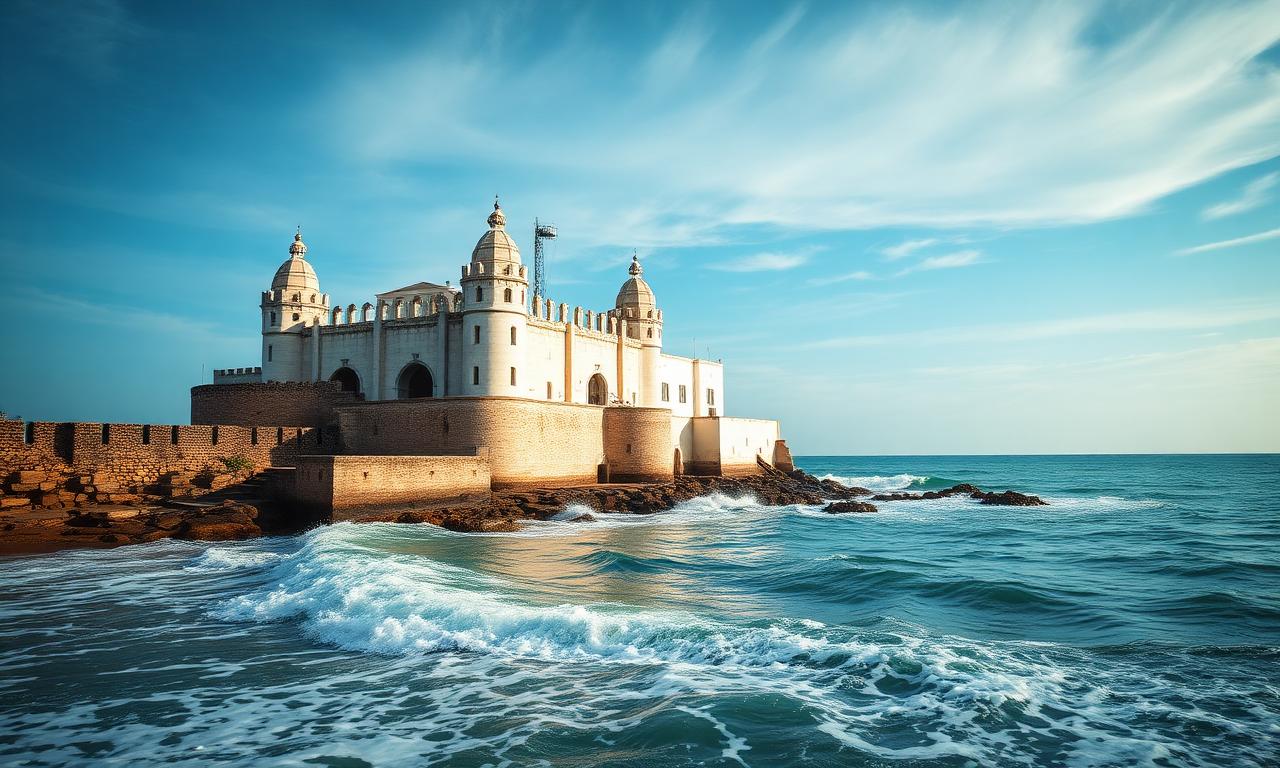
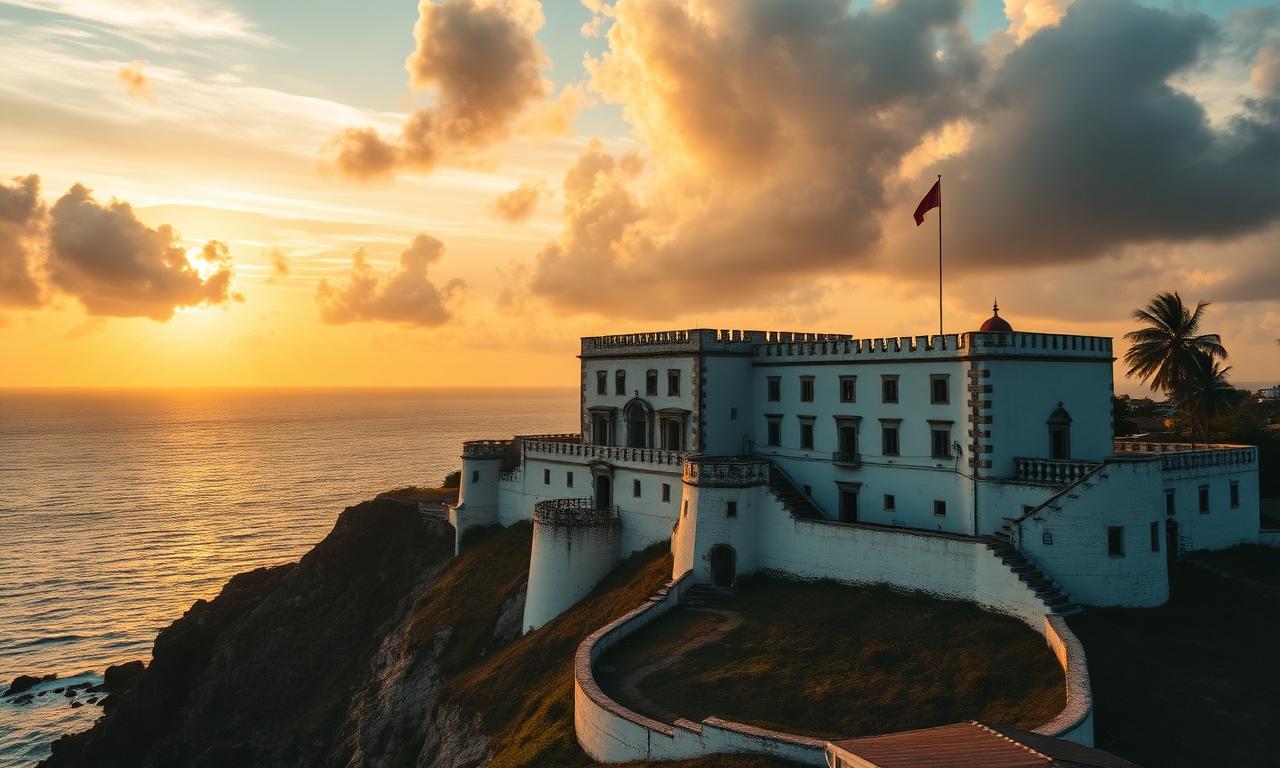
Standing tall on the rocky shore of Cape Coast in the Central Region of Ghana, Cape Coast Castle is one of the most powerful and saddest historical sites in all of Africa. Its bright white walls hide a very dark story.
For hundreds of years, this castle was a place where thousands of African men, women and children were kept in chains before being shipped across the Atlantic Ocean to become slaves in the Americas.
Who Built Cape Coast Castle?
Cape Coast Castle was first built in 1653 by the Swedes as a small wooden trading post for timber and gold. It was called Carolusborg, after the Swedish king Charles X.
Over the next century the castle changed hands several times among European powers — the Danes, the Dutch, the local Fetu kingdom, and finally the British, who took control in 1664.
The British rebuilt the castle in stone and made it the headquarters of their entire Gold Coast operations. From here they ruled their trade and later their colonial empire on the coast.
From Gold Trade to Slave Trade
At first, the trade in this part of the coast was mostly in gold, ivory and timber — which is why Europeans called the area 'the Gold Coast'.
By the 1700s, however, the demand for cheap labour in the sugar plantations of the Caribbean and the cotton fields of the southern United States was huge. European traders began to focus more and more on buying captured Africans from inland kingdoms.
Cape Coast Castle became the largest British slave-holding centre in West Africa. Estimates suggest that hundreds of thousands of Africans passed through its dungeons.
Inside the Dungeons
Beneath the castle are dark, airless underground rooms called dungeons. Up to a thousand men could be packed into one chamber, with very little water and almost no toilets. Women were kept in separate dungeons.
Captives sometimes waited for weeks or months in these dungeons before a ship arrived. Many died from disease, hunger or suffocation.
Those who survived were marched in chains through a narrow tunnel that ended at a small wooden door facing the sea. This door is called the 'Door of No Return'. Once you stepped through it, you would never see Africa again.
Advertisement
End of the Slave Trade
In 1807 the British Parliament abolished the trade in enslaved Africans. Slavery itself was abolished in the British Empire in 1834.
Cape Coast Castle then became an administrative centre and later a school. After Ghana's independence in 1957 it was preserved as a historical monument.
Cape Coast Castle Today
Today the castle is open to the public. It is a UNESCO World Heritage Site and a powerful museum about the trans-Atlantic slave trade. Tours led by knowledgeable Ghanaian guides take visitors through the dungeons, the governor's quarters and the Door of No Return.
Many African-Americans and people from the Caribbean make emotional pilgrimages to Cape Coast to reconnect with their roots.
Famous visitors have included U.S. Presidents Barack Obama (2009) and Bill Clinton, as well as Maya Angelou and many world leaders.
Understanding the background
Cape Coast Castle is an important topic because it helps learners connect names, dates, places and decisions to the wider story of Ghana. The subject belongs to castles & forts, but it also links with citizenship, geography, culture and moral education. When students read about Cape Coast Castle, they are not only memorising facts; they are learning how people solved problems, protected communities, built institutions and passed lessons from one generation to another.
A useful way to study this topic is to begin with the main evidence. One important fact is: Built: 1653 (rebuilt many times). Another point to remember is: First builders: Swedes. These details give the article a clear anchor. They help learners explain what happened, where it happened, who was involved and why the event or place remains important in Ghanaian life today.
The story should also be read with empathy. History is about real people: leaders making hard choices, ordinary families facing change, traders moving goods, chiefs protecting their people, students demanding a better future, and communities keeping traditions alive. Some parts of Ghana's past are joyful and proud, while others are painful. A good reader respects both sides and tries to understand the human experience behind the facts.
For long reading, pause after each section and ask three simple questions: What is the main idea? Which details support it? How does it connect to Ghana today? This method makes Cape Coast Castle easier to remember and easier to discuss in class. It also helps learners write stronger essays because every paragraph can be connected to a clear point, a clear example and a clear explanation.
This topic is also useful for national identity. Ghana is made up of many regions, languages, ethnic groups, faiths and occupations, yet the history of the country shows repeated efforts to build unity. Whether the topic is a president, a castle, a kingdom, a region, a festival or a national event, the lesson is that Ghana's story was built by many hands. Understanding Cape Coast Castle helps learners appreciate that shared responsibility.
When preparing for quizzes or examinations, learners should create a short timeline, write down key names, mark important places on a map and explain the meaning of each fact in their own words. Copying sentences is less helpful than retelling the story clearly. If a learner can explain Cape Coast Castle to a younger pupil in simple English, then the learner has truly understood the topic.
People, places and decisions
Cape Coast Castle is an important topic because it helps learners connect names, dates, places and decisions to the wider story of Ghana. The subject belongs to castles & forts, but it also links with citizenship, geography, culture and moral education. When students read about Cape Coast Castle, they are not only memorising facts; they are learning how people solved problems, protected communities, built institutions and passed lessons from one generation to another.
A useful way to study this topic is to begin with the main evidence. One important fact is: First builders: Swedes. Another point to remember is: Final colonial owners: British. These details give the article a clear anchor. They help learners explain what happened, where it happened, who was involved and why the event or place remains important in Ghanaian life today.
The story should also be read with empathy. History is about real people: leaders making hard choices, ordinary families facing change, traders moving goods, chiefs protecting their people, students demanding a better future, and communities keeping traditions alive. Some parts of Ghana's past are joyful and proud, while others are painful. A good reader respects both sides and tries to understand the human experience behind the facts.
For long reading, pause after each section and ask three simple questions: What is the main idea? Which details support it? How does it connect to Ghana today? This method makes Cape Coast Castle easier to remember and easier to discuss in class. It also helps learners write stronger essays because every paragraph can be connected to a clear point, a clear example and a clear explanation.
This topic is also useful for national identity. Ghana is made up of many regions, languages, ethnic groups, faiths and occupations, yet the history of the country shows repeated efforts to build unity. Whether the topic is a president, a castle, a kingdom, a region, a festival or a national event, the lesson is that Ghana's story was built by many hands. Understanding Cape Coast Castle helps learners appreciate that shared responsibility.
When preparing for quizzes or examinations, learners should create a short timeline, write down key names, mark important places on a map and explain the meaning of each fact in their own words. Copying sentences is less helpful than retelling the story clearly. If a learner can explain Cape Coast Castle to a younger pupil in simple English, then the learner has truly understood the topic.
Cause and effect
Cape Coast Castle is an important topic because it helps learners connect names, dates, places and decisions to the wider story of Ghana. The subject belongs to castles & forts, but it also links with citizenship, geography, culture and moral education. When students read about Cape Coast Castle, they are not only memorising facts; they are learning how people solved problems, protected communities, built institutions and passed lessons from one generation to another.
A useful way to study this topic is to begin with the main evidence. One important fact is: Final colonial owners: British. Another point to remember is: Location: Cape Coast, Central Region. These details give the article a clear anchor. They help learners explain what happened, where it happened, who was involved and why the event or place remains important in Ghanaian life today.
The story should also be read with empathy. History is about real people: leaders making hard choices, ordinary families facing change, traders moving goods, chiefs protecting their people, students demanding a better future, and communities keeping traditions alive. Some parts of Ghana's past are joyful and proud, while others are painful. A good reader respects both sides and tries to understand the human experience behind the facts.
For long reading, pause after each section and ask three simple questions: What is the main idea? Which details support it? How does it connect to Ghana today? This method makes Cape Coast Castle easier to remember and easier to discuss in class. It also helps learners write stronger essays because every paragraph can be connected to a clear point, a clear example and a clear explanation.
This topic is also useful for national identity. Ghana is made up of many regions, languages, ethnic groups, faiths and occupations, yet the history of the country shows repeated efforts to build unity. Whether the topic is a president, a castle, a kingdom, a region, a festival or a national event, the lesson is that Ghana's story was built by many hands. Understanding Cape Coast Castle helps learners appreciate that shared responsibility.
When preparing for quizzes or examinations, learners should create a short timeline, write down key names, mark important places on a map and explain the meaning of each fact in their own words. Copying sentences is less helpful than retelling the story clearly. If a learner can explain Cape Coast Castle to a younger pupil in simple English, then the learner has truly understood the topic.
Life in Ghana at the time
Cape Coast Castle is an important topic because it helps learners connect names, dates, places and decisions to the wider story of Ghana. The subject belongs to castles & forts, but it also links with citizenship, geography, culture and moral education. When students read about Cape Coast Castle, they are not only memorising facts; they are learning how people solved problems, protected communities, built institutions and passed lessons from one generation to another.
A useful way to study this topic is to begin with the main evidence. One important fact is: Location: Cape Coast, Central Region. Another point to remember is: Status: UNESCO World Heritage Site (1979). These details give the article a clear anchor. They help learners explain what happened, where it happened, who was involved and why the event or place remains important in Ghanaian life today.
The story should also be read with empathy. History is about real people: leaders making hard choices, ordinary families facing change, traders moving goods, chiefs protecting their people, students demanding a better future, and communities keeping traditions alive. Some parts of Ghana's past are joyful and proud, while others are painful. A good reader respects both sides and tries to understand the human experience behind the facts.
For long reading, pause after each section and ask three simple questions: What is the main idea? Which details support it? How does it connect to Ghana today? This method makes Cape Coast Castle easier to remember and easier to discuss in class. It also helps learners write stronger essays because every paragraph can be connected to a clear point, a clear example and a clear explanation.
This topic is also useful for national identity. Ghana is made up of many regions, languages, ethnic groups, faiths and occupations, yet the history of the country shows repeated efforts to build unity. Whether the topic is a president, a castle, a kingdom, a region, a festival or a national event, the lesson is that Ghana's story was built by many hands. Understanding Cape Coast Castle helps learners appreciate that shared responsibility.
When preparing for quizzes or examinations, learners should create a short timeline, write down key names, mark important places on a map and explain the meaning of each fact in their own words. Copying sentences is less helpful than retelling the story clearly. If a learner can explain Cape Coast Castle to a younger pupil in simple English, then the learner has truly understood the topic.
Why the topic matters today
Cape Coast Castle is an important topic because it helps learners connect names, dates, places and decisions to the wider story of Ghana. The subject belongs to castles & forts, but it also links with citizenship, geography, culture and moral education. When students read about Cape Coast Castle, they are not only memorising facts; they are learning how people solved problems, protected communities, built institutions and passed lessons from one generation to another.
A useful way to study this topic is to begin with the main evidence. One important fact is: Status: UNESCO World Heritage Site (1979). Another point to remember is: Notable feature: the Door of No Return. These details give the article a clear anchor. They help learners explain what happened, where it happened, who was involved and why the event or place remains important in Ghanaian life today.
The story should also be read with empathy. History is about real people: leaders making hard choices, ordinary families facing change, traders moving goods, chiefs protecting their people, students demanding a better future, and communities keeping traditions alive. Some parts of Ghana's past are joyful and proud, while others are painful. A good reader respects both sides and tries to understand the human experience behind the facts.
For long reading, pause after each section and ask three simple questions: What is the main idea? Which details support it? How does it connect to Ghana today? This method makes Cape Coast Castle easier to remember and easier to discuss in class. It also helps learners write stronger essays because every paragraph can be connected to a clear point, a clear example and a clear explanation.
This topic is also useful for national identity. Ghana is made up of many regions, languages, ethnic groups, faiths and occupations, yet the history of the country shows repeated efforts to build unity. Whether the topic is a president, a castle, a kingdom, a region, a festival or a national event, the lesson is that Ghana's story was built by many hands. Understanding Cape Coast Castle helps learners appreciate that shared responsibility.
When preparing for quizzes or examinations, learners should create a short timeline, write down key names, mark important places on a map and explain the meaning of each fact in their own words. Copying sentences is less helpful than retelling the story clearly. If a learner can explain Cape Coast Castle to a younger pupil in simple English, then the learner has truly understood the topic.
Common misunderstandings
Cape Coast Castle is an important topic because it helps learners connect names, dates, places and decisions to the wider story of Ghana. The subject belongs to castles & forts, but it also links with citizenship, geography, culture and moral education. When students read about Cape Coast Castle, they are not only memorising facts; they are learning how people solved problems, protected communities, built institutions and passed lessons from one generation to another.
A useful way to study this topic is to begin with the main evidence. One important fact is: Notable feature: the Door of No Return. Another point to remember is: Built: 1653 (rebuilt many times). These details give the article a clear anchor. They help learners explain what happened, where it happened, who was involved and why the event or place remains important in Ghanaian life today.
The story should also be read with empathy. History is about real people: leaders making hard choices, ordinary families facing change, traders moving goods, chiefs protecting their people, students demanding a better future, and communities keeping traditions alive. Some parts of Ghana's past are joyful and proud, while others are painful. A good reader respects both sides and tries to understand the human experience behind the facts.
For long reading, pause after each section and ask three simple questions: What is the main idea? Which details support it? How does it connect to Ghana today? This method makes Cape Coast Castle easier to remember and easier to discuss in class. It also helps learners write stronger essays because every paragraph can be connected to a clear point, a clear example and a clear explanation.
This topic is also useful for national identity. Ghana is made up of many regions, languages, ethnic groups, faiths and occupations, yet the history of the country shows repeated efforts to build unity. Whether the topic is a president, a castle, a kingdom, a region, a festival or a national event, the lesson is that Ghana's story was built by many hands. Understanding Cape Coast Castle helps learners appreciate that shared responsibility.
When preparing for quizzes or examinations, learners should create a short timeline, write down key names, mark important places on a map and explain the meaning of each fact in their own words. Copying sentences is less helpful than retelling the story clearly. If a learner can explain Cape Coast Castle to a younger pupil in simple English, then the learner has truly understood the topic.
Classroom study notes
Cape Coast Castle is an important topic because it helps learners connect names, dates, places and decisions to the wider story of Ghana. The subject belongs to castles & forts, but it also links with citizenship, geography, culture and moral education. When students read about Cape Coast Castle, they are not only memorising facts; they are learning how people solved problems, protected communities, built institutions and passed lessons from one generation to another.
A useful way to study this topic is to begin with the main evidence. One important fact is: Built: 1653 (rebuilt many times). Another point to remember is: First builders: Swedes. These details give the article a clear anchor. They help learners explain what happened, where it happened, who was involved and why the event or place remains important in Ghanaian life today.
The story should also be read with empathy. History is about real people: leaders making hard choices, ordinary families facing change, traders moving goods, chiefs protecting their people, students demanding a better future, and communities keeping traditions alive. Some parts of Ghana's past are joyful and proud, while others are painful. A good reader respects both sides and tries to understand the human experience behind the facts.
For long reading, pause after each section and ask three simple questions: What is the main idea? Which details support it? How does it connect to Ghana today? This method makes Cape Coast Castle easier to remember and easier to discuss in class. It also helps learners write stronger essays because every paragraph can be connected to a clear point, a clear example and a clear explanation.
This topic is also useful for national identity. Ghana is made up of many regions, languages, ethnic groups, faiths and occupations, yet the history of the country shows repeated efforts to build unity. Whether the topic is a president, a castle, a kingdom, a region, a festival or a national event, the lesson is that Ghana's story was built by many hands. Understanding Cape Coast Castle helps learners appreciate that shared responsibility.
When preparing for quizzes or examinations, learners should create a short timeline, write down key names, mark important places on a map and explain the meaning of each fact in their own words. Copying sentences is less helpful than retelling the story clearly. If a learner can explain Cape Coast Castle to a younger pupil in simple English, then the learner has truly understood the topic.
How to remember the lesson
Cape Coast Castle is an important topic because it helps learners connect names, dates, places and decisions to the wider story of Ghana. The subject belongs to castles & forts, but it also links with citizenship, geography, culture and moral education. When students read about Cape Coast Castle, they are not only memorising facts; they are learning how people solved problems, protected communities, built institutions and passed lessons from one generation to another.
A useful way to study this topic is to begin with the main evidence. One important fact is: First builders: Swedes. Another point to remember is: Final colonial owners: British. These details give the article a clear anchor. They help learners explain what happened, where it happened, who was involved and why the event or place remains important in Ghanaian life today.
The story should also be read with empathy. History is about real people: leaders making hard choices, ordinary families facing change, traders moving goods, chiefs protecting their people, students demanding a better future, and communities keeping traditions alive. Some parts of Ghana's past are joyful and proud, while others are painful. A good reader respects both sides and tries to understand the human experience behind the facts.
For long reading, pause after each section and ask three simple questions: What is the main idea? Which details support it? How does it connect to Ghana today? This method makes Cape Coast Castle easier to remember and easier to discuss in class. It also helps learners write stronger essays because every paragraph can be connected to a clear point, a clear example and a clear explanation.
This topic is also useful for national identity. Ghana is made up of many regions, languages, ethnic groups, faiths and occupations, yet the history of the country shows repeated efforts to build unity. Whether the topic is a president, a castle, a kingdom, a region, a festival or a national event, the lesson is that Ghana's story was built by many hands. Understanding Cape Coast Castle helps learners appreciate that shared responsibility.
When preparing for quizzes or examinations, learners should create a short timeline, write down key names, mark important places on a map and explain the meaning of each fact in their own words. Copying sentences is less helpful than retelling the story clearly. If a learner can explain Cape Coast Castle to a younger pupil in simple English, then the learner has truly understood the topic.
Questions for deeper thinking
Cape Coast Castle is an important topic because it helps learners connect names, dates, places and decisions to the wider story of Ghana. The subject belongs to castles & forts, but it also links with citizenship, geography, culture and moral education. When students read about Cape Coast Castle, they are not only memorising facts; they are learning how people solved problems, protected communities, built institutions and passed lessons from one generation to another.
A useful way to study this topic is to begin with the main evidence. One important fact is: Final colonial owners: British. Another point to remember is: Location: Cape Coast, Central Region. These details give the article a clear anchor. They help learners explain what happened, where it happened, who was involved and why the event or place remains important in Ghanaian life today.
The story should also be read with empathy. History is about real people: leaders making hard choices, ordinary families facing change, traders moving goods, chiefs protecting their people, students demanding a better future, and communities keeping traditions alive. Some parts of Ghana's past are joyful and proud, while others are painful. A good reader respects both sides and tries to understand the human experience behind the facts.
For long reading, pause after each section and ask three simple questions: What is the main idea? Which details support it? How does it connect to Ghana today? This method makes Cape Coast Castle easier to remember and easier to discuss in class. It also helps learners write stronger essays because every paragraph can be connected to a clear point, a clear example and a clear explanation.
This topic is also useful for national identity. Ghana is made up of many regions, languages, ethnic groups, faiths and occupations, yet the history of the country shows repeated efforts to build unity. Whether the topic is a president, a castle, a kingdom, a region, a festival or a national event, the lesson is that Ghana's story was built by many hands. Understanding Cape Coast Castle helps learners appreciate that shared responsibility.
When preparing for quizzes or examinations, learners should create a short timeline, write down key names, mark important places on a map and explain the meaning of each fact in their own words. Copying sentences is less helpful than retelling the story clearly. If a learner can explain Cape Coast Castle to a younger pupil in simple English, then the learner has truly understood the topic.
Summary
Cape Coast Castle reminds the world of one of the worst crimes in human history — the trans-Atlantic slave trade. Visiting it is sad, but it is also a moment to honour the millions of African ancestors who suffered there and to commit ourselves to never let such cruelty happen again.
Frequently Asked Questions
Q:Why is Cape Coast Castle famous?
Because for centuries it was a major holding centre for enslaved Africans before they were shipped to the Americas.
Q:What is the 'Door of No Return'?
A small wooden door at the back of the castle facing the sea. Captives walked through it onto slave ships and were never able to return home.
Q:Who manages the castle today?
The Ghana Museums and Monuments Board, in partnership with UNESCO.