
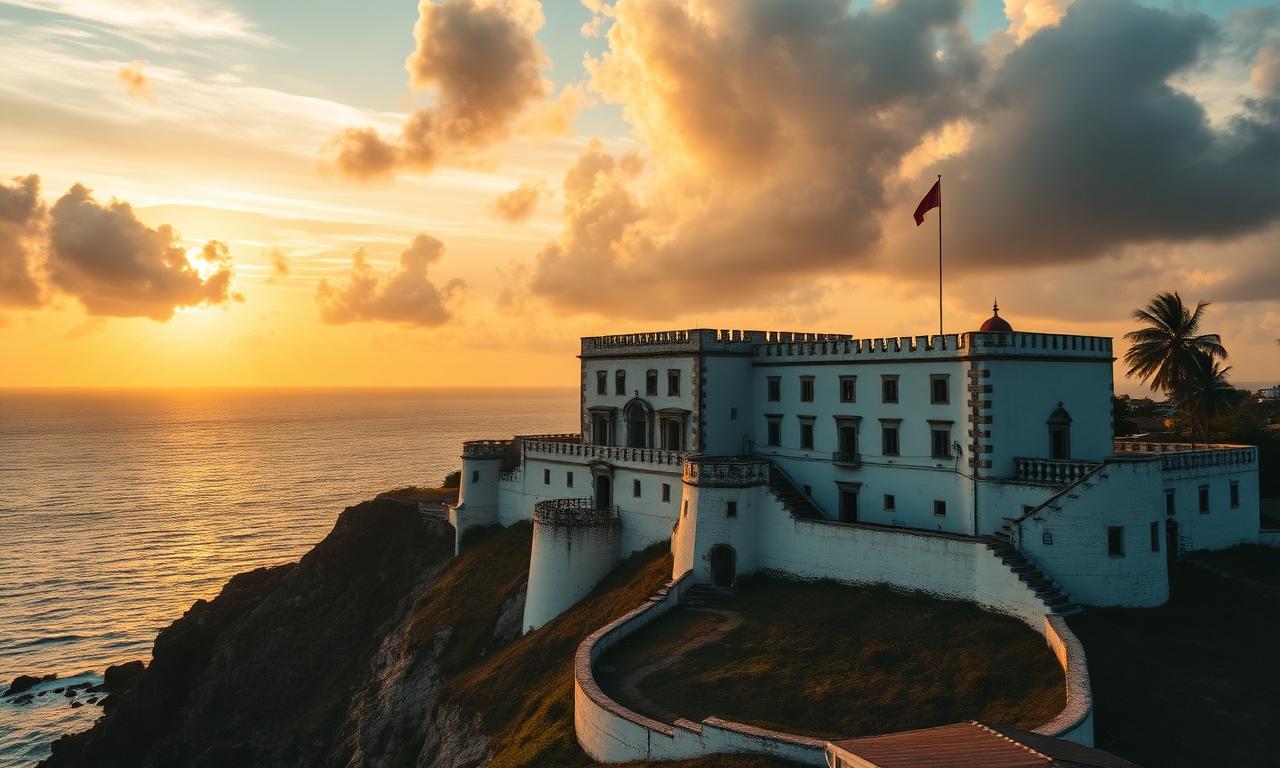
If Cape Coast Castle tells the story of the slave trade, Christiansborg Castle — popularly known as Osu Castle — tells the story of Ghana's modern political life. For most of Ghana's independent history, this was where the country was governed from.
It stands on a rocky stretch of coast in the Osu neighbourhood of Accra, looking out over the Atlantic Ocean.
Danish Origins
Christiansborg Castle was built by the Danes in 1661 on a piece of land bought from the local Ga people. They named it after the Danish King Christian V — 'Christiansborg' means 'Christian's fortress'.
Before the Danes, the Portuguese and Swedes had small trading posts in the same area. Over the years the castle changed hands many times — Portuguese, Akwamu (a local Ghanaian kingdom that briefly captured it in 1693), Danes again, and finally the British in 1850.
Role in the Slave Trade
Christiansborg Castle was also used to hold enslaved Africans before they were shipped to the Danish West Indies (today the U.S. Virgin Islands) and other parts of the Americas.
Denmark was actually the first European country to outlaw the trans-Atlantic slave trade in 1803.
Seat of Colonial Government
When the British took over in 1850, Christiansborg Castle became the headquarters of their colonial government for the Gold Coast. Governors lived and worked here.
An earthquake in 1862 badly damaged the castle and it was rebuilt.
Advertisement
Independence and the Presidency
After Ghana's independence in 1957, Christiansborg Castle became 'The Castle' — the seat of the Government of Ghana and the official office of every President, from Kwame Nkrumah to John Atta Mills.
Important state ceremonies, swearing-in of presidents, cabinet meetings and visits from foreign leaders all happened here.
From The Castle to Jubilee House
In 2008 a new presidential palace called Jubilee House (briefly named Flagstaff House) was built off the Liberation Road in Accra. President John Atta Mills officially moved the seat of government there in 2013.
Christiansborg Castle is now being turned into a Presidential Museum. When it opens, visitors will be able to walk through the offices once used by all of Ghana's presidents.
Understanding the background
Christiansborg Castle (Osu Castle) is an important topic because it helps learners connect names, dates, places and decisions to the wider story of Ghana. The subject belongs to castles & forts, but it also links with citizenship, geography, culture and moral education. When students read about Christiansborg Castle (Osu Castle), they are not only memorising facts; they are learning how people solved problems, protected communities, built institutions and passed lessons from one generation to another.
A useful way to study this topic is to begin with the main evidence. One important fact is: Built: 1661 by the Danes. Another point to remember is: Other names: Osu Castle, 'The Castle'. These details give the article a clear anchor. They help learners explain what happened, where it happened, who was involved and why the event or place remains important in Ghanaian life today.
The story should also be read with empathy. History is about real people: leaders making hard choices, ordinary families facing change, traders moving goods, chiefs protecting their people, students demanding a better future, and communities keeping traditions alive. Some parts of Ghana's past are joyful and proud, while others are painful. A good reader respects both sides and tries to understand the human experience behind the facts.
For long reading, pause after each section and ask three simple questions: What is the main idea? Which details support it? How does it connect to Ghana today? This method makes Christiansborg Castle (Osu Castle) easier to remember and easier to discuss in class. It also helps learners write stronger essays because every paragraph can be connected to a clear point, a clear example and a clear explanation.
This topic is also useful for national identity. Ghana is made up of many regions, languages, ethnic groups, faiths and occupations, yet the history of the country shows repeated efforts to build unity. Whether the topic is a president, a castle, a kingdom, a region, a festival or a national event, the lesson is that Ghana's story was built by many hands. Understanding Christiansborg Castle (Osu Castle) helps learners appreciate that shared responsibility.
When preparing for quizzes or examinations, learners should create a short timeline, write down key names, mark important places on a map and explain the meaning of each fact in their own words. Copying sentences is less helpful than retelling the story clearly. If a learner can explain Christiansborg Castle (Osu Castle) to a younger pupil in simple English, then the learner has truly understood the topic.
People, places and decisions
Christiansborg Castle (Osu Castle) is an important topic because it helps learners connect names, dates, places and decisions to the wider story of Ghana. The subject belongs to castles & forts, but it also links with citizenship, geography, culture and moral education. When students read about Christiansborg Castle (Osu Castle), they are not only memorising facts; they are learning how people solved problems, protected communities, built institutions and passed lessons from one generation to another.
A useful way to study this topic is to begin with the main evidence. One important fact is: Other names: Osu Castle, 'The Castle'. Another point to remember is: Location: Osu, Accra. These details give the article a clear anchor. They help learners explain what happened, where it happened, who was involved and why the event or place remains important in Ghanaian life today.
The story should also be read with empathy. History is about real people: leaders making hard choices, ordinary families facing change, traders moving goods, chiefs protecting their people, students demanding a better future, and communities keeping traditions alive. Some parts of Ghana's past are joyful and proud, while others are painful. A good reader respects both sides and tries to understand the human experience behind the facts.
For long reading, pause after each section and ask three simple questions: What is the main idea? Which details support it? How does it connect to Ghana today? This method makes Christiansborg Castle (Osu Castle) easier to remember and easier to discuss in class. It also helps learners write stronger essays because every paragraph can be connected to a clear point, a clear example and a clear explanation.
This topic is also useful for national identity. Ghana is made up of many regions, languages, ethnic groups, faiths and occupations, yet the history of the country shows repeated efforts to build unity. Whether the topic is a president, a castle, a kingdom, a region, a festival or a national event, the lesson is that Ghana's story was built by many hands. Understanding Christiansborg Castle (Osu Castle) helps learners appreciate that shared responsibility.
When preparing for quizzes or examinations, learners should create a short timeline, write down key names, mark important places on a map and explain the meaning of each fact in their own words. Copying sentences is less helpful than retelling the story clearly. If a learner can explain Christiansborg Castle (Osu Castle) to a younger pupil in simple English, then the learner has truly understood the topic.
Cause and effect
Christiansborg Castle (Osu Castle) is an important topic because it helps learners connect names, dates, places and decisions to the wider story of Ghana. The subject belongs to castles & forts, but it also links with citizenship, geography, culture and moral education. When students read about Christiansborg Castle (Osu Castle), they are not only memorising facts; they are learning how people solved problems, protected communities, built institutions and passed lessons from one generation to another.
A useful way to study this topic is to begin with the main evidence. One important fact is: Location: Osu, Accra. Another point to remember is: Served as seat of government: 1957 – 2013. These details give the article a clear anchor. They help learners explain what happened, where it happened, who was involved and why the event or place remains important in Ghanaian life today.
The story should also be read with empathy. History is about real people: leaders making hard choices, ordinary families facing change, traders moving goods, chiefs protecting their people, students demanding a better future, and communities keeping traditions alive. Some parts of Ghana's past are joyful and proud, while others are painful. A good reader respects both sides and tries to understand the human experience behind the facts.
For long reading, pause after each section and ask three simple questions: What is the main idea? Which details support it? How does it connect to Ghana today? This method makes Christiansborg Castle (Osu Castle) easier to remember and easier to discuss in class. It also helps learners write stronger essays because every paragraph can be connected to a clear point, a clear example and a clear explanation.
This topic is also useful for national identity. Ghana is made up of many regions, languages, ethnic groups, faiths and occupations, yet the history of the country shows repeated efforts to build unity. Whether the topic is a president, a castle, a kingdom, a region, a festival or a national event, the lesson is that Ghana's story was built by many hands. Understanding Christiansborg Castle (Osu Castle) helps learners appreciate that shared responsibility.
When preparing for quizzes or examinations, learners should create a short timeline, write down key names, mark important places on a map and explain the meaning of each fact in their own words. Copying sentences is less helpful than retelling the story clearly. If a learner can explain Christiansborg Castle (Osu Castle) to a younger pupil in simple English, then the learner has truly understood the topic.
Life in Ghana at the time
Christiansborg Castle (Osu Castle) is an important topic because it helps learners connect names, dates, places and decisions to the wider story of Ghana. The subject belongs to castles & forts, but it also links with citizenship, geography, culture and moral education. When students read about Christiansborg Castle (Osu Castle), they are not only memorising facts; they are learning how people solved problems, protected communities, built institutions and passed lessons from one generation to another.
A useful way to study this topic is to begin with the main evidence. One important fact is: Served as seat of government: 1957 – 2013. Another point to remember is: Current use: being developed as a Presidential Museum. These details give the article a clear anchor. They help learners explain what happened, where it happened, who was involved and why the event or place remains important in Ghanaian life today.
The story should also be read with empathy. History is about real people: leaders making hard choices, ordinary families facing change, traders moving goods, chiefs protecting their people, students demanding a better future, and communities keeping traditions alive. Some parts of Ghana's past are joyful and proud, while others are painful. A good reader respects both sides and tries to understand the human experience behind the facts.
For long reading, pause after each section and ask three simple questions: What is the main idea? Which details support it? How does it connect to Ghana today? This method makes Christiansborg Castle (Osu Castle) easier to remember and easier to discuss in class. It also helps learners write stronger essays because every paragraph can be connected to a clear point, a clear example and a clear explanation.
This topic is also useful for national identity. Ghana is made up of many regions, languages, ethnic groups, faiths and occupations, yet the history of the country shows repeated efforts to build unity. Whether the topic is a president, a castle, a kingdom, a region, a festival or a national event, the lesson is that Ghana's story was built by many hands. Understanding Christiansborg Castle (Osu Castle) helps learners appreciate that shared responsibility.
When preparing for quizzes or examinations, learners should create a short timeline, write down key names, mark important places on a map and explain the meaning of each fact in their own words. Copying sentences is less helpful than retelling the story clearly. If a learner can explain Christiansborg Castle (Osu Castle) to a younger pupil in simple English, then the learner has truly understood the topic.
Why the topic matters today
Christiansborg Castle (Osu Castle) is an important topic because it helps learners connect names, dates, places and decisions to the wider story of Ghana. The subject belongs to castles & forts, but it also links with citizenship, geography, culture and moral education. When students read about Christiansborg Castle (Osu Castle), they are not only memorising facts; they are learning how people solved problems, protected communities, built institutions and passed lessons from one generation to another.
A useful way to study this topic is to begin with the main evidence. One important fact is: Current use: being developed as a Presidential Museum. Another point to remember is: Built: 1661 by the Danes. These details give the article a clear anchor. They help learners explain what happened, where it happened, who was involved and why the event or place remains important in Ghanaian life today.
The story should also be read with empathy. History is about real people: leaders making hard choices, ordinary families facing change, traders moving goods, chiefs protecting their people, students demanding a better future, and communities keeping traditions alive. Some parts of Ghana's past are joyful and proud, while others are painful. A good reader respects both sides and tries to understand the human experience behind the facts.
For long reading, pause after each section and ask three simple questions: What is the main idea? Which details support it? How does it connect to Ghana today? This method makes Christiansborg Castle (Osu Castle) easier to remember and easier to discuss in class. It also helps learners write stronger essays because every paragraph can be connected to a clear point, a clear example and a clear explanation.
This topic is also useful for national identity. Ghana is made up of many regions, languages, ethnic groups, faiths and occupations, yet the history of the country shows repeated efforts to build unity. Whether the topic is a president, a castle, a kingdom, a region, a festival or a national event, the lesson is that Ghana's story was built by many hands. Understanding Christiansborg Castle (Osu Castle) helps learners appreciate that shared responsibility.
When preparing for quizzes or examinations, learners should create a short timeline, write down key names, mark important places on a map and explain the meaning of each fact in their own words. Copying sentences is less helpful than retelling the story clearly. If a learner can explain Christiansborg Castle (Osu Castle) to a younger pupil in simple English, then the learner has truly understood the topic.
Common misunderstandings
Christiansborg Castle (Osu Castle) is an important topic because it helps learners connect names, dates, places and decisions to the wider story of Ghana. The subject belongs to castles & forts, but it also links with citizenship, geography, culture and moral education. When students read about Christiansborg Castle (Osu Castle), they are not only memorising facts; they are learning how people solved problems, protected communities, built institutions and passed lessons from one generation to another.
A useful way to study this topic is to begin with the main evidence. One important fact is: Built: 1661 by the Danes. Another point to remember is: Other names: Osu Castle, 'The Castle'. These details give the article a clear anchor. They help learners explain what happened, where it happened, who was involved and why the event or place remains important in Ghanaian life today.
The story should also be read with empathy. History is about real people: leaders making hard choices, ordinary families facing change, traders moving goods, chiefs protecting their people, students demanding a better future, and communities keeping traditions alive. Some parts of Ghana's past are joyful and proud, while others are painful. A good reader respects both sides and tries to understand the human experience behind the facts.
For long reading, pause after each section and ask three simple questions: What is the main idea? Which details support it? How does it connect to Ghana today? This method makes Christiansborg Castle (Osu Castle) easier to remember and easier to discuss in class. It also helps learners write stronger essays because every paragraph can be connected to a clear point, a clear example and a clear explanation.
This topic is also useful for national identity. Ghana is made up of many regions, languages, ethnic groups, faiths and occupations, yet the history of the country shows repeated efforts to build unity. Whether the topic is a president, a castle, a kingdom, a region, a festival or a national event, the lesson is that Ghana's story was built by many hands. Understanding Christiansborg Castle (Osu Castle) helps learners appreciate that shared responsibility.
When preparing for quizzes or examinations, learners should create a short timeline, write down key names, mark important places on a map and explain the meaning of each fact in their own words. Copying sentences is less helpful than retelling the story clearly. If a learner can explain Christiansborg Castle (Osu Castle) to a younger pupil in simple English, then the learner has truly understood the topic.
Classroom study notes
Christiansborg Castle (Osu Castle) is an important topic because it helps learners connect names, dates, places and decisions to the wider story of Ghana. The subject belongs to castles & forts, but it also links with citizenship, geography, culture and moral education. When students read about Christiansborg Castle (Osu Castle), they are not only memorising facts; they are learning how people solved problems, protected communities, built institutions and passed lessons from one generation to another.
A useful way to study this topic is to begin with the main evidence. One important fact is: Other names: Osu Castle, 'The Castle'. Another point to remember is: Location: Osu, Accra. These details give the article a clear anchor. They help learners explain what happened, where it happened, who was involved and why the event or place remains important in Ghanaian life today.
The story should also be read with empathy. History is about real people: leaders making hard choices, ordinary families facing change, traders moving goods, chiefs protecting their people, students demanding a better future, and communities keeping traditions alive. Some parts of Ghana's past are joyful and proud, while others are painful. A good reader respects both sides and tries to understand the human experience behind the facts.
For long reading, pause after each section and ask three simple questions: What is the main idea? Which details support it? How does it connect to Ghana today? This method makes Christiansborg Castle (Osu Castle) easier to remember and easier to discuss in class. It also helps learners write stronger essays because every paragraph can be connected to a clear point, a clear example and a clear explanation.
This topic is also useful for national identity. Ghana is made up of many regions, languages, ethnic groups, faiths and occupations, yet the history of the country shows repeated efforts to build unity. Whether the topic is a president, a castle, a kingdom, a region, a festival or a national event, the lesson is that Ghana's story was built by many hands. Understanding Christiansborg Castle (Osu Castle) helps learners appreciate that shared responsibility.
When preparing for quizzes or examinations, learners should create a short timeline, write down key names, mark important places on a map and explain the meaning of each fact in their own words. Copying sentences is less helpful than retelling the story clearly. If a learner can explain Christiansborg Castle (Osu Castle) to a younger pupil in simple English, then the learner has truly understood the topic.
How to remember the lesson
Christiansborg Castle (Osu Castle) is an important topic because it helps learners connect names, dates, places and decisions to the wider story of Ghana. The subject belongs to castles & forts, but it also links with citizenship, geography, culture and moral education. When students read about Christiansborg Castle (Osu Castle), they are not only memorising facts; they are learning how people solved problems, protected communities, built institutions and passed lessons from one generation to another.
A useful way to study this topic is to begin with the main evidence. One important fact is: Location: Osu, Accra. Another point to remember is: Served as seat of government: 1957 – 2013. These details give the article a clear anchor. They help learners explain what happened, where it happened, who was involved and why the event or place remains important in Ghanaian life today.
The story should also be read with empathy. History is about real people: leaders making hard choices, ordinary families facing change, traders moving goods, chiefs protecting their people, students demanding a better future, and communities keeping traditions alive. Some parts of Ghana's past are joyful and proud, while others are painful. A good reader respects both sides and tries to understand the human experience behind the facts.
For long reading, pause after each section and ask three simple questions: What is the main idea? Which details support it? How does it connect to Ghana today? This method makes Christiansborg Castle (Osu Castle) easier to remember and easier to discuss in class. It also helps learners write stronger essays because every paragraph can be connected to a clear point, a clear example and a clear explanation.
This topic is also useful for national identity. Ghana is made up of many regions, languages, ethnic groups, faiths and occupations, yet the history of the country shows repeated efforts to build unity. Whether the topic is a president, a castle, a kingdom, a region, a festival or a national event, the lesson is that Ghana's story was built by many hands. Understanding Christiansborg Castle (Osu Castle) helps learners appreciate that shared responsibility.
When preparing for quizzes or examinations, learners should create a short timeline, write down key names, mark important places on a map and explain the meaning of each fact in their own words. Copying sentences is less helpful than retelling the story clearly. If a learner can explain Christiansborg Castle (Osu Castle) to a younger pupil in simple English, then the learner has truly understood the topic.
Questions for deeper thinking
Christiansborg Castle (Osu Castle) is an important topic because it helps learners connect names, dates, places and decisions to the wider story of Ghana. The subject belongs to castles & forts, but it also links with citizenship, geography, culture and moral education. When students read about Christiansborg Castle (Osu Castle), they are not only memorising facts; they are learning how people solved problems, protected communities, built institutions and passed lessons from one generation to another.
A useful way to study this topic is to begin with the main evidence. One important fact is: Served as seat of government: 1957 – 2013. Another point to remember is: Current use: being developed as a Presidential Museum. These details give the article a clear anchor. They help learners explain what happened, where it happened, who was involved and why the event or place remains important in Ghanaian life today.
The story should also be read with empathy. History is about real people: leaders making hard choices, ordinary families facing change, traders moving goods, chiefs protecting their people, students demanding a better future, and communities keeping traditions alive. Some parts of Ghana's past are joyful and proud, while others are painful. A good reader respects both sides and tries to understand the human experience behind the facts.
For long reading, pause after each section and ask three simple questions: What is the main idea? Which details support it? How does it connect to Ghana today? This method makes Christiansborg Castle (Osu Castle) easier to remember and easier to discuss in class. It also helps learners write stronger essays because every paragraph can be connected to a clear point, a clear example and a clear explanation.
This topic is also useful for national identity. Ghana is made up of many regions, languages, ethnic groups, faiths and occupations, yet the history of the country shows repeated efforts to build unity. Whether the topic is a president, a castle, a kingdom, a region, a festival or a national event, the lesson is that Ghana's story was built by many hands. Understanding Christiansborg Castle (Osu Castle) helps learners appreciate that shared responsibility.
When preparing for quizzes or examinations, learners should create a short timeline, write down key names, mark important places on a map and explain the meaning of each fact in their own words. Copying sentences is less helpful than retelling the story clearly. If a learner can explain Christiansborg Castle (Osu Castle) to a younger pupil in simple English, then the learner has truly understood the topic.
Summary
Christiansborg Castle is woven into almost every chapter of Ghana's modern story — from the slave trade and colonial rule to independence and the Fourth Republic. Soon, as a museum, it will let young Ghanaians walk right where their presidents once worked.
Frequently Asked Questions
Q:Why is it called Osu Castle?
Because it sits in the Osu neighbourhood of Accra, on land that belonged to the Ga people of Osu.
Q:Is the castle still used by the President?
No. Since 2013 the President works from Jubilee House.
Q:Can I visit the castle?
Tours are limited at the moment, but plans are underway to open it fully as a Presidential Museum.