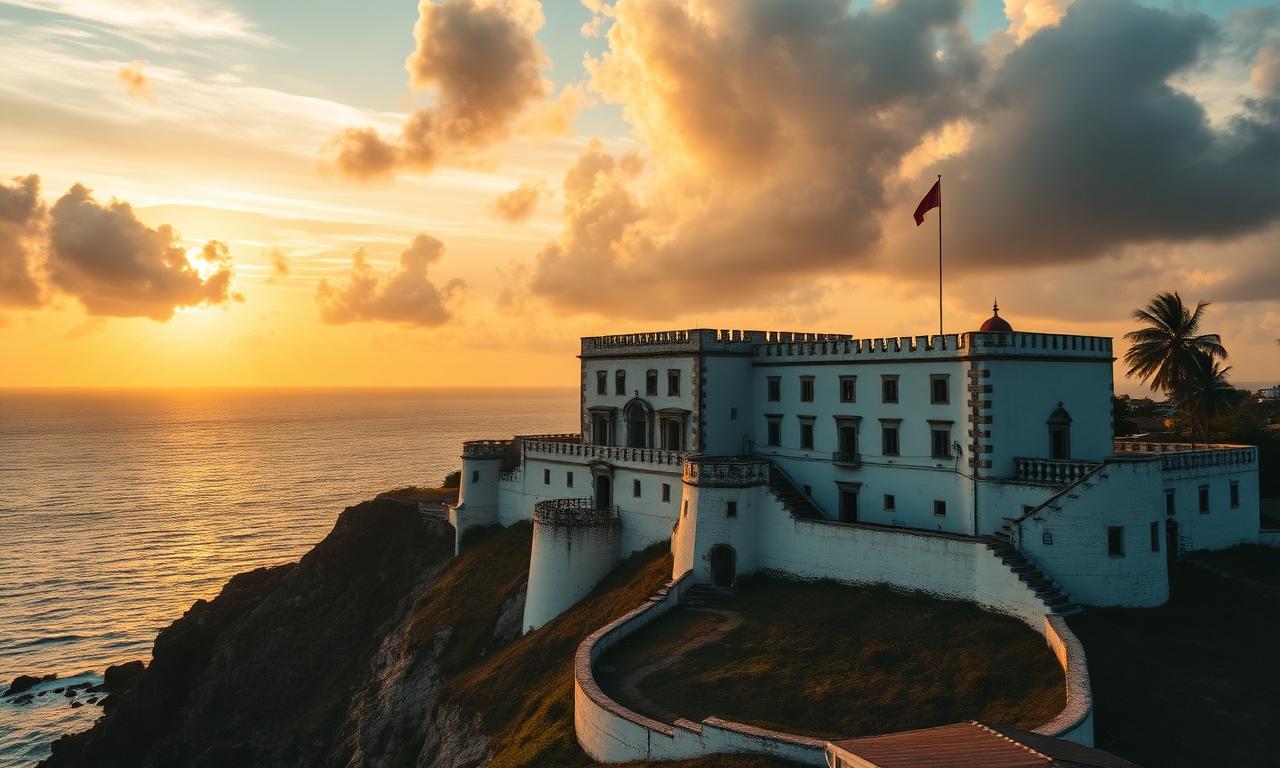
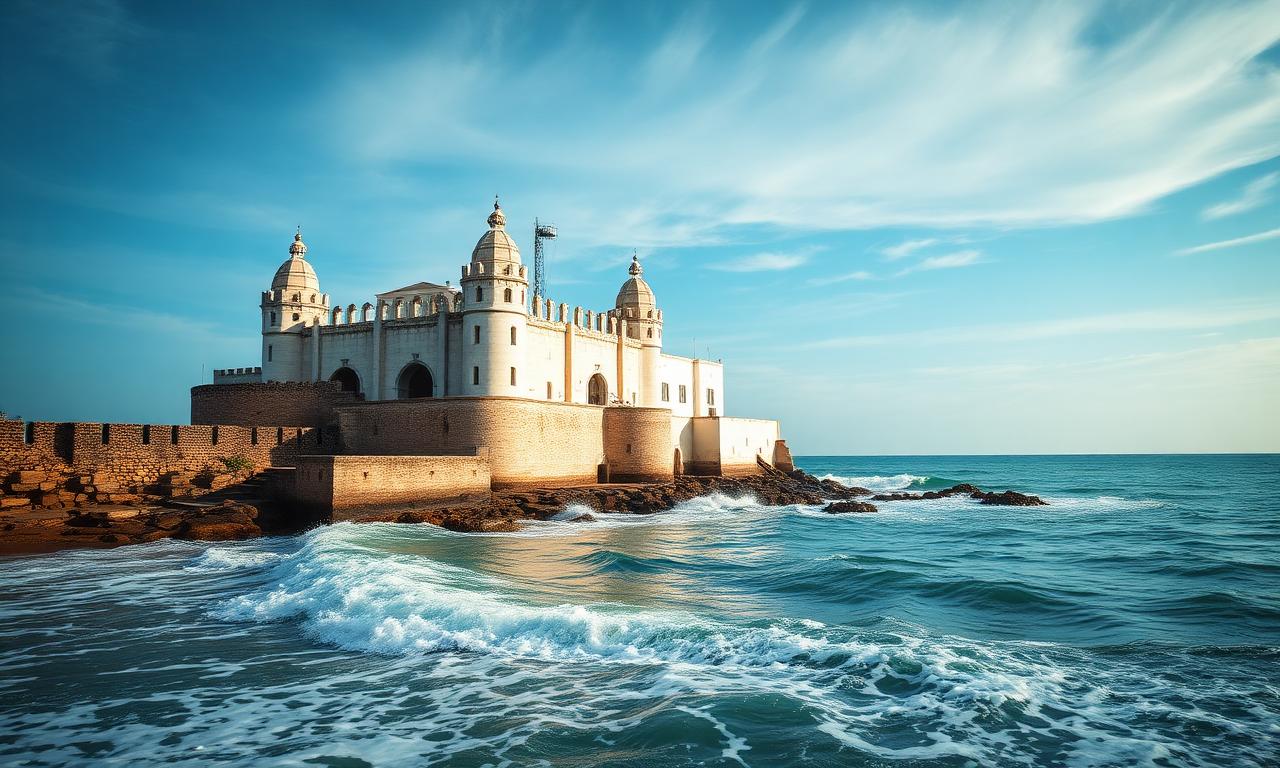
Just a few kilometres west of Cape Coast lies another grand white castle by the sea — Elmina Castle, also known by its Portuguese name São Jorge da Mina ('St. George of the Mine').
Built in 1482, it is the oldest European-built structure standing in sub-Saharan Africa. Like Cape Coast Castle, it has a story full of glory, gold, trade and tragedy.
The Portuguese Arrival
In 1471 the Portuguese sailors Soeiro da Costa, João de Santarém and Pedro Escobar reached the area now known as Elmina. They were amazed by the gold dust traded by the local Fante and Fetu peoples.
King John II of Portugal sent an expedition under Diogo de Azambuja to build a strong fortress to protect the gold trade. Construction began on 21 January 1482 — and within just twenty days the main walls were standing.
It was the first permanent European building south of the Sahara.
Trading Gold and Slaves
For the first century, Elmina was mostly about gold. Then, like Cape Coast, it became a major slave-holding centre.
Captured Africans were marched in long lines from inland to be sold to the Portuguese traders. They were kept in damp dungeons before being put on ships bound for Brazil and other parts of the Americas.
Dutch and British Periods
In 1637 the Dutch seized Elmina from the Portuguese and made it the centre of their West African empire for over 200 years.
In 1872 the Dutch sold all their forts on the Gold Coast — including Elmina — to the British. This made Britain the only European power on the coast and helped lead to full colonial rule.
Advertisement
Layout of the Castle
Elmina Castle has a chapel, large courtyards, a governor's living quarters and a separate building called Fort St. Jago on a hill across the lagoon. Below ground are the male and female dungeons.
It also has its own Door of No Return facing the sea, similar to the one at Cape Coast Castle.
Visiting Elmina Today
Like Cape Coast Castle, Elmina is a UNESCO World Heritage Site. It is open every day and welcomes thousands of visitors a year, including schoolchildren from across Ghana.
The bustling fishing town of Elmina around the castle is itself a wonderful place to walk through. The colourful canoes, lively market and old buildings show that the town is very much alive today.
Understanding the background
Elmina Castle (São Jorge da Mina) is an important topic because it helps learners connect names, dates, places and decisions to the wider story of Ghana. The subject belongs to castles & forts, but it also links with citizenship, geography, culture and moral education. When students read about Elmina Castle (São Jorge da Mina), they are not only memorising facts; they are learning how people solved problems, protected communities, built institutions and passed lessons from one generation to another.
A useful way to study this topic is to begin with the main evidence. One important fact is: Built: 1482 by the Portuguese. Another point to remember is: Original name: São Jorge da Mina. These details give the article a clear anchor. They help learners explain what happened, where it happened, who was involved and why the event or place remains important in Ghanaian life today.
The story should also be read with empathy. History is about real people: leaders making hard choices, ordinary families facing change, traders moving goods, chiefs protecting their people, students demanding a better future, and communities keeping traditions alive. Some parts of Ghana's past are joyful and proud, while others are painful. A good reader respects both sides and tries to understand the human experience behind the facts.
For long reading, pause after each section and ask three simple questions: What is the main idea? Which details support it? How does it connect to Ghana today? This method makes Elmina Castle (São Jorge da Mina) easier to remember and easier to discuss in class. It also helps learners write stronger essays because every paragraph can be connected to a clear point, a clear example and a clear explanation.
This topic is also useful for national identity. Ghana is made up of many regions, languages, ethnic groups, faiths and occupations, yet the history of the country shows repeated efforts to build unity. Whether the topic is a president, a castle, a kingdom, a region, a festival or a national event, the lesson is that Ghana's story was built by many hands. Understanding Elmina Castle (São Jorge da Mina) helps learners appreciate that shared responsibility.
When preparing for quizzes or examinations, learners should create a short timeline, write down key names, mark important places on a map and explain the meaning of each fact in their own words. Copying sentences is less helpful than retelling the story clearly. If a learner can explain Elmina Castle (São Jorge da Mina) to a younger pupil in simple English, then the learner has truly understood the topic.
People, places and decisions
Elmina Castle (São Jorge da Mina) is an important topic because it helps learners connect names, dates, places and decisions to the wider story of Ghana. The subject belongs to castles & forts, but it also links with citizenship, geography, culture and moral education. When students read about Elmina Castle (São Jorge da Mina), they are not only memorising facts; they are learning how people solved problems, protected communities, built institutions and passed lessons from one generation to another.
A useful way to study this topic is to begin with the main evidence. One important fact is: Original name: São Jorge da Mina. Another point to remember is: Dutch takeover: 1637. These details give the article a clear anchor. They help learners explain what happened, where it happened, who was involved and why the event or place remains important in Ghanaian life today.
The story should also be read with empathy. History is about real people: leaders making hard choices, ordinary families facing change, traders moving goods, chiefs protecting their people, students demanding a better future, and communities keeping traditions alive. Some parts of Ghana's past are joyful and proud, while others are painful. A good reader respects both sides and tries to understand the human experience behind the facts.
For long reading, pause after each section and ask three simple questions: What is the main idea? Which details support it? How does it connect to Ghana today? This method makes Elmina Castle (São Jorge da Mina) easier to remember and easier to discuss in class. It also helps learners write stronger essays because every paragraph can be connected to a clear point, a clear example and a clear explanation.
This topic is also useful for national identity. Ghana is made up of many regions, languages, ethnic groups, faiths and occupations, yet the history of the country shows repeated efforts to build unity. Whether the topic is a president, a castle, a kingdom, a region, a festival or a national event, the lesson is that Ghana's story was built by many hands. Understanding Elmina Castle (São Jorge da Mina) helps learners appreciate that shared responsibility.
When preparing for quizzes or examinations, learners should create a short timeline, write down key names, mark important places on a map and explain the meaning of each fact in their own words. Copying sentences is less helpful than retelling the story clearly. If a learner can explain Elmina Castle (São Jorge da Mina) to a younger pupil in simple English, then the learner has truly understood the topic.
Cause and effect
Elmina Castle (São Jorge da Mina) is an important topic because it helps learners connect names, dates, places and decisions to the wider story of Ghana. The subject belongs to castles & forts, but it also links with citizenship, geography, culture and moral education. When students read about Elmina Castle (São Jorge da Mina), they are not only memorising facts; they are learning how people solved problems, protected communities, built institutions and passed lessons from one generation to another.
A useful way to study this topic is to begin with the main evidence. One important fact is: Dutch takeover: 1637. Another point to remember is: British takeover: 1872. These details give the article a clear anchor. They help learners explain what happened, where it happened, who was involved and why the event or place remains important in Ghanaian life today.
The story should also be read with empathy. History is about real people: leaders making hard choices, ordinary families facing change, traders moving goods, chiefs protecting their people, students demanding a better future, and communities keeping traditions alive. Some parts of Ghana's past are joyful and proud, while others are painful. A good reader respects both sides and tries to understand the human experience behind the facts.
For long reading, pause after each section and ask three simple questions: What is the main idea? Which details support it? How does it connect to Ghana today? This method makes Elmina Castle (São Jorge da Mina) easier to remember and easier to discuss in class. It also helps learners write stronger essays because every paragraph can be connected to a clear point, a clear example and a clear explanation.
This topic is also useful for national identity. Ghana is made up of many regions, languages, ethnic groups, faiths and occupations, yet the history of the country shows repeated efforts to build unity. Whether the topic is a president, a castle, a kingdom, a region, a festival or a national event, the lesson is that Ghana's story was built by many hands. Understanding Elmina Castle (São Jorge da Mina) helps learners appreciate that shared responsibility.
When preparing for quizzes or examinations, learners should create a short timeline, write down key names, mark important places on a map and explain the meaning of each fact in their own words. Copying sentences is less helpful than retelling the story clearly. If a learner can explain Elmina Castle (São Jorge da Mina) to a younger pupil in simple English, then the learner has truly understood the topic.
Life in Ghana at the time
Elmina Castle (São Jorge da Mina) is an important topic because it helps learners connect names, dates, places and decisions to the wider story of Ghana. The subject belongs to castles & forts, but it also links with citizenship, geography, culture and moral education. When students read about Elmina Castle (São Jorge da Mina), they are not only memorising facts; they are learning how people solved problems, protected communities, built institutions and passed lessons from one generation to another.
A useful way to study this topic is to begin with the main evidence. One important fact is: British takeover: 1872. Another point to remember is: Status: UNESCO World Heritage Site. These details give the article a clear anchor. They help learners explain what happened, where it happened, who was involved and why the event or place remains important in Ghanaian life today.
The story should also be read with empathy. History is about real people: leaders making hard choices, ordinary families facing change, traders moving goods, chiefs protecting their people, students demanding a better future, and communities keeping traditions alive. Some parts of Ghana's past are joyful and proud, while others are painful. A good reader respects both sides and tries to understand the human experience behind the facts.
For long reading, pause after each section and ask three simple questions: What is the main idea? Which details support it? How does it connect to Ghana today? This method makes Elmina Castle (São Jorge da Mina) easier to remember and easier to discuss in class. It also helps learners write stronger essays because every paragraph can be connected to a clear point, a clear example and a clear explanation.
This topic is also useful for national identity. Ghana is made up of many regions, languages, ethnic groups, faiths and occupations, yet the history of the country shows repeated efforts to build unity. Whether the topic is a president, a castle, a kingdom, a region, a festival or a national event, the lesson is that Ghana's story was built by many hands. Understanding Elmina Castle (São Jorge da Mina) helps learners appreciate that shared responsibility.
When preparing for quizzes or examinations, learners should create a short timeline, write down key names, mark important places on a map and explain the meaning of each fact in their own words. Copying sentences is less helpful than retelling the story clearly. If a learner can explain Elmina Castle (São Jorge da Mina) to a younger pupil in simple English, then the learner has truly understood the topic.
Why the topic matters today
Elmina Castle (São Jorge da Mina) is an important topic because it helps learners connect names, dates, places and decisions to the wider story of Ghana. The subject belongs to castles & forts, but it also links with citizenship, geography, culture and moral education. When students read about Elmina Castle (São Jorge da Mina), they are not only memorising facts; they are learning how people solved problems, protected communities, built institutions and passed lessons from one generation to another.
A useful way to study this topic is to begin with the main evidence. One important fact is: Status: UNESCO World Heritage Site. Another point to remember is: Town: Elmina, Central Region. These details give the article a clear anchor. They help learners explain what happened, where it happened, who was involved and why the event or place remains important in Ghanaian life today.
The story should also be read with empathy. History is about real people: leaders making hard choices, ordinary families facing change, traders moving goods, chiefs protecting their people, students demanding a better future, and communities keeping traditions alive. Some parts of Ghana's past are joyful and proud, while others are painful. A good reader respects both sides and tries to understand the human experience behind the facts.
For long reading, pause after each section and ask three simple questions: What is the main idea? Which details support it? How does it connect to Ghana today? This method makes Elmina Castle (São Jorge da Mina) easier to remember and easier to discuss in class. It also helps learners write stronger essays because every paragraph can be connected to a clear point, a clear example and a clear explanation.
This topic is also useful for national identity. Ghana is made up of many regions, languages, ethnic groups, faiths and occupations, yet the history of the country shows repeated efforts to build unity. Whether the topic is a president, a castle, a kingdom, a region, a festival or a national event, the lesson is that Ghana's story was built by many hands. Understanding Elmina Castle (São Jorge da Mina) helps learners appreciate that shared responsibility.
When preparing for quizzes or examinations, learners should create a short timeline, write down key names, mark important places on a map and explain the meaning of each fact in their own words. Copying sentences is less helpful than retelling the story clearly. If a learner can explain Elmina Castle (São Jorge da Mina) to a younger pupil in simple English, then the learner has truly understood the topic.
Common misunderstandings
Elmina Castle (São Jorge da Mina) is an important topic because it helps learners connect names, dates, places and decisions to the wider story of Ghana. The subject belongs to castles & forts, but it also links with citizenship, geography, culture and moral education. When students read about Elmina Castle (São Jorge da Mina), they are not only memorising facts; they are learning how people solved problems, protected communities, built institutions and passed lessons from one generation to another.
A useful way to study this topic is to begin with the main evidence. One important fact is: Town: Elmina, Central Region. Another point to remember is: Built: 1482 by the Portuguese. These details give the article a clear anchor. They help learners explain what happened, where it happened, who was involved and why the event or place remains important in Ghanaian life today.
The story should also be read with empathy. History is about real people: leaders making hard choices, ordinary families facing change, traders moving goods, chiefs protecting their people, students demanding a better future, and communities keeping traditions alive. Some parts of Ghana's past are joyful and proud, while others are painful. A good reader respects both sides and tries to understand the human experience behind the facts.
For long reading, pause after each section and ask three simple questions: What is the main idea? Which details support it? How does it connect to Ghana today? This method makes Elmina Castle (São Jorge da Mina) easier to remember and easier to discuss in class. It also helps learners write stronger essays because every paragraph can be connected to a clear point, a clear example and a clear explanation.
This topic is also useful for national identity. Ghana is made up of many regions, languages, ethnic groups, faiths and occupations, yet the history of the country shows repeated efforts to build unity. Whether the topic is a president, a castle, a kingdom, a region, a festival or a national event, the lesson is that Ghana's story was built by many hands. Understanding Elmina Castle (São Jorge da Mina) helps learners appreciate that shared responsibility.
When preparing for quizzes or examinations, learners should create a short timeline, write down key names, mark important places on a map and explain the meaning of each fact in their own words. Copying sentences is less helpful than retelling the story clearly. If a learner can explain Elmina Castle (São Jorge da Mina) to a younger pupil in simple English, then the learner has truly understood the topic.
Classroom study notes
Elmina Castle (São Jorge da Mina) is an important topic because it helps learners connect names, dates, places and decisions to the wider story of Ghana. The subject belongs to castles & forts, but it also links with citizenship, geography, culture and moral education. When students read about Elmina Castle (São Jorge da Mina), they are not only memorising facts; they are learning how people solved problems, protected communities, built institutions and passed lessons from one generation to another.
A useful way to study this topic is to begin with the main evidence. One important fact is: Built: 1482 by the Portuguese. Another point to remember is: Original name: São Jorge da Mina. These details give the article a clear anchor. They help learners explain what happened, where it happened, who was involved and why the event or place remains important in Ghanaian life today.
The story should also be read with empathy. History is about real people: leaders making hard choices, ordinary families facing change, traders moving goods, chiefs protecting their people, students demanding a better future, and communities keeping traditions alive. Some parts of Ghana's past are joyful and proud, while others are painful. A good reader respects both sides and tries to understand the human experience behind the facts.
For long reading, pause after each section and ask three simple questions: What is the main idea? Which details support it? How does it connect to Ghana today? This method makes Elmina Castle (São Jorge da Mina) easier to remember and easier to discuss in class. It also helps learners write stronger essays because every paragraph can be connected to a clear point, a clear example and a clear explanation.
This topic is also useful for national identity. Ghana is made up of many regions, languages, ethnic groups, faiths and occupations, yet the history of the country shows repeated efforts to build unity. Whether the topic is a president, a castle, a kingdom, a region, a festival or a national event, the lesson is that Ghana's story was built by many hands. Understanding Elmina Castle (São Jorge da Mina) helps learners appreciate that shared responsibility.
When preparing for quizzes or examinations, learners should create a short timeline, write down key names, mark important places on a map and explain the meaning of each fact in their own words. Copying sentences is less helpful than retelling the story clearly. If a learner can explain Elmina Castle (São Jorge da Mina) to a younger pupil in simple English, then the learner has truly understood the topic.
How to remember the lesson
Elmina Castle (São Jorge da Mina) is an important topic because it helps learners connect names, dates, places and decisions to the wider story of Ghana. The subject belongs to castles & forts, but it also links with citizenship, geography, culture and moral education. When students read about Elmina Castle (São Jorge da Mina), they are not only memorising facts; they are learning how people solved problems, protected communities, built institutions and passed lessons from one generation to another.
A useful way to study this topic is to begin with the main evidence. One important fact is: Original name: São Jorge da Mina. Another point to remember is: Dutch takeover: 1637. These details give the article a clear anchor. They help learners explain what happened, where it happened, who was involved and why the event or place remains important in Ghanaian life today.
The story should also be read with empathy. History is about real people: leaders making hard choices, ordinary families facing change, traders moving goods, chiefs protecting their people, students demanding a better future, and communities keeping traditions alive. Some parts of Ghana's past are joyful and proud, while others are painful. A good reader respects both sides and tries to understand the human experience behind the facts.
For long reading, pause after each section and ask three simple questions: What is the main idea? Which details support it? How does it connect to Ghana today? This method makes Elmina Castle (São Jorge da Mina) easier to remember and easier to discuss in class. It also helps learners write stronger essays because every paragraph can be connected to a clear point, a clear example and a clear explanation.
This topic is also useful for national identity. Ghana is made up of many regions, languages, ethnic groups, faiths and occupations, yet the history of the country shows repeated efforts to build unity. Whether the topic is a president, a castle, a kingdom, a region, a festival or a national event, the lesson is that Ghana's story was built by many hands. Understanding Elmina Castle (São Jorge da Mina) helps learners appreciate that shared responsibility.
When preparing for quizzes or examinations, learners should create a short timeline, write down key names, mark important places on a map and explain the meaning of each fact in their own words. Copying sentences is less helpful than retelling the story clearly. If a learner can explain Elmina Castle (São Jorge da Mina) to a younger pupil in simple English, then the learner has truly understood the topic.
Questions for deeper thinking
Elmina Castle (São Jorge da Mina) is an important topic because it helps learners connect names, dates, places and decisions to the wider story of Ghana. The subject belongs to castles & forts, but it also links with citizenship, geography, culture and moral education. When students read about Elmina Castle (São Jorge da Mina), they are not only memorising facts; they are learning how people solved problems, protected communities, built institutions and passed lessons from one generation to another.
A useful way to study this topic is to begin with the main evidence. One important fact is: Dutch takeover: 1637. Another point to remember is: British takeover: 1872. These details give the article a clear anchor. They help learners explain what happened, where it happened, who was involved and why the event or place remains important in Ghanaian life today.
The story should also be read with empathy. History is about real people: leaders making hard choices, ordinary families facing change, traders moving goods, chiefs protecting their people, students demanding a better future, and communities keeping traditions alive. Some parts of Ghana's past are joyful and proud, while others are painful. A good reader respects both sides and tries to understand the human experience behind the facts.
For long reading, pause after each section and ask three simple questions: What is the main idea? Which details support it? How does it connect to Ghana today? This method makes Elmina Castle (São Jorge da Mina) easier to remember and easier to discuss in class. It also helps learners write stronger essays because every paragraph can be connected to a clear point, a clear example and a clear explanation.
This topic is also useful for national identity. Ghana is made up of many regions, languages, ethnic groups, faiths and occupations, yet the history of the country shows repeated efforts to build unity. Whether the topic is a president, a castle, a kingdom, a region, a festival or a national event, the lesson is that Ghana's story was built by many hands. Understanding Elmina Castle (São Jorge da Mina) helps learners appreciate that shared responsibility.
When preparing for quizzes or examinations, learners should create a short timeline, write down key names, mark important places on a map and explain the meaning of each fact in their own words. Copying sentences is less helpful than retelling the story clearly. If a learner can explain Elmina Castle (São Jorge da Mina) to a younger pupil in simple English, then the learner has truly understood the topic.
Summary
Elmina Castle is the oldest European building in sub-Saharan Africa. It tells the story of how Europe and Africa first met in trade — first in gold, then tragically in slaves. Visiting Elmina is a powerful way to learn this important history.
Frequently Asked Questions
Q:Who built Elmina Castle?
The Portuguese, starting on 21 January 1482, under Diogo de Azambuja.
Q:What does 'Elmina' mean?
It comes from the Portuguese phrase 'A Mina' meaning 'the mine', referring to the gold mines of the area.
Q:Are Elmina and Cape Coast Castles the same?
No. They are different castles in different towns, but both are UNESCO sites and both played roles in the slave trade.