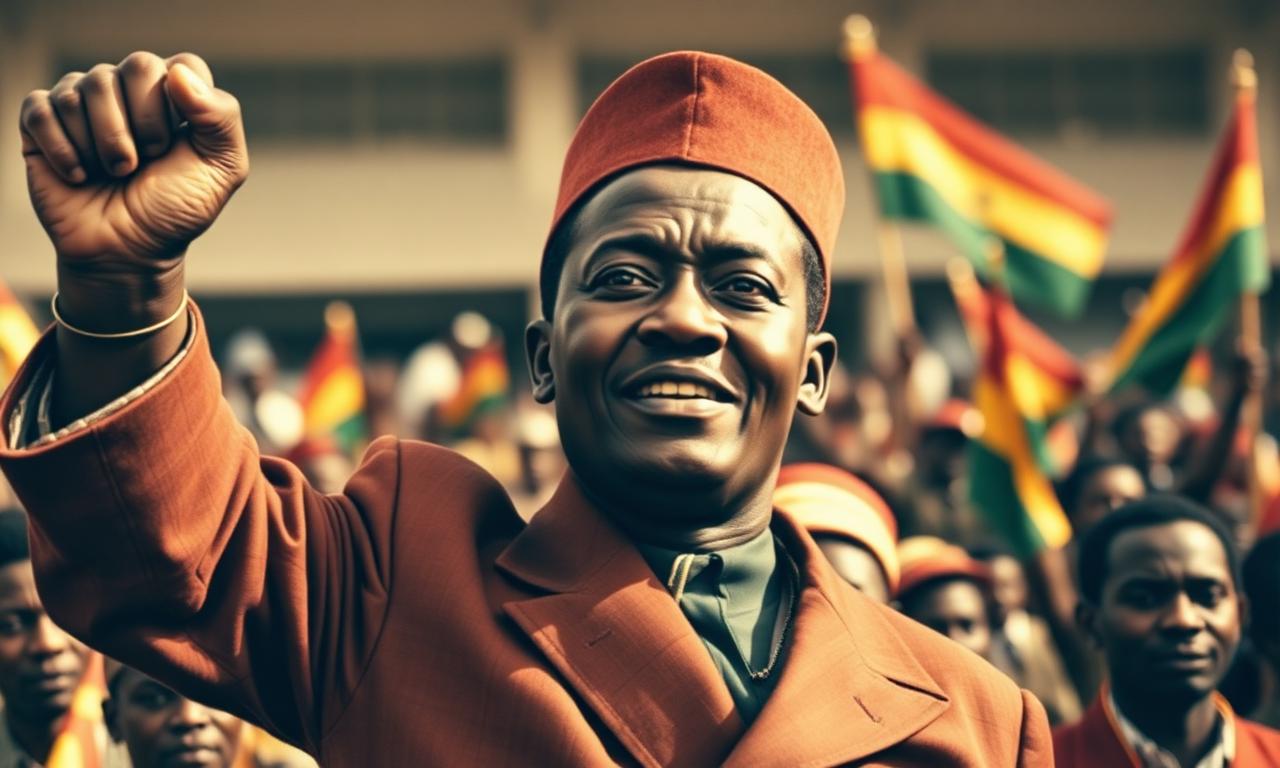
Since independence in 1957, Ghana has been led by many different leaders. Some were civilian presidents elected by the people. Others took power through military coups. Together, their stories tell the story of Ghana's growing democracy.
Below is a clear guide to every head of state in order, with their dates, their party and what they are most remembered for.
Kwame Nkrumah (1960–1966)
Kwame Nkrumah was the first Prime Minister (from 1957) and the first President (from 1 July 1960). He led the Convention People's Party (CPP).
He is remembered for building the Akosombo Dam, Tema Harbour, KNUST and many schools. He gave Ghana free primary education and pushed strongly for African unity.
He was overthrown by a military coup on 24 February 1966 while he was on a trip to Vietnam.
The National Liberation Council (NLC) (1966–1969)
After Nkrumah's overthrow, soldiers and police ruled the country. The chairmen of this military council were Lt. Gen. Joseph Arthur Ankrah (1966–1969) and then Brig. Akwasi Amankwaa Afrifa (1969).
The NLC banned political parties for a while, then organised elections and handed power to civilians in October 1969.
Dr. Kofi Abrefa Busia and Edward Akufo-Addo (1969–1972)
Ghana's Second Republic had a ceremonial President, Edward Akufo-Addo, and a Prime Minister with real power, Dr. Kofi Abrefa Busia of the Progress Party.
Busia is remembered for his 'Alliance for Progress' programme, the expulsion of foreigners under the Aliens Compliance Order, and the brave decision to devalue the cedi to fix the economy.
His government was overthrown by Col. Ignatius Kutu Acheampong on 13 January 1972.
Advertisement
Acheampong and Akuffo (1972–1979)
Col. (later Gen.) Ignatius Acheampong ruled first as Chairman of the National Redemption Council and then the Supreme Military Council (SMC). His slogan 'Operation Feed Yourself' encouraged farming.
He was forced out in a palace coup in July 1978. Lt. Gen. Fred Akuffo took over until 4 June 1979 when junior officers led by Flt. Lt. Jerry John Rawlings staged the 'House Cleaning Exercise'. Acheampong, Afrifa and Akuffo were executed.
Dr. Hilla Limann (1979–1981)
After the 1979 elections Dr. Hilla Limann of the People's National Party (PNP) became President of the short-lived Third Republic. He came from Gwollu in the Upper West Region.
His government faced a tough economy. On 31 December 1981 Rawlings struck again and ended the Third Republic.
Flt. Lt. Jerry John Rawlings (1981–2001)
Rawlings ruled as Chairman of the Provisional National Defence Council (PNDC) from 1981. In 1992 he wrote a new constitution, founded the National Democratic Congress (NDC) and won the elections that started the Fourth Republic.
He served two elected terms as President (1993–2001). He is remembered for the Economic Recovery Programme, decentralisation through district assemblies and a return to civilian rule.
John Agyekum Kufuor (2001–2009)
John Agyekum Kufuor of the New Patriotic Party (NPP) won the 2000 elections and served two terms. He is remembered for the National Health Insurance Scheme (NHIS), the School Feeding Programme and the Metro Mass Transit buses. Under him Ghana found commercial oil in 2007.
Prof. John Evans Atta Mills (2009–2012)
Prof. Mills of the NDC, a quiet law professor, won the very close 2008 elections. He focused on 'Better Ghana' policies and oil production began under him in 2010. He sadly died in office on 24 July 2012.
John Dramani Mahama (2012–2017, 2025–)
John Mahama was Vice President under Mills and became President after Mills' death. He won the 2012 election in his own right. His first term faced power shortages known as 'dumsor'.
He lost in 2016, returned to opposition, and made a remarkable comeback when he won the 2024 election. He was sworn in for a second term on 7 January 2025, becoming the only Ghanaian leader to serve two non-consecutive terms.
Nana Addo Dankwa Akufo-Addo (2017–2025)
Son of former President Edward Akufo-Addo, Nana Addo of the NPP won the 2016 and 2020 elections. He launched the Free Senior High School policy, One District One Factory, Planting for Food and Jobs and digital reforms such as the Ghana Card.
He handed over to John Mahama on 7 January 2025.
Understanding the background
Presidents of Ghana — From Nkrumah to Today is an important topic because it helps learners connect names, dates, places and decisions to the wider story of Ghana. The subject belongs to presidents, but it also links with citizenship, geography, culture and moral education. When students read about Presidents of Ghana — From Nkrumah to Today, they are not only memorising facts; they are learning how people solved problems, protected communities, built institutions and passed lessons from one generation to another.
A useful way to study this topic is to begin with the main evidence. One important fact is: First President: Kwame Nkrumah (1960). Another point to remember is: First female Speaker of Parliament: Joyce Bamford-Addo (2009). These details give the article a clear anchor. They help learners explain what happened, where it happened, who was involved and why the event or place remains important in Ghanaian life today.
The story should also be read with empathy. History is about real people: leaders making hard choices, ordinary families facing change, traders moving goods, chiefs protecting their people, students demanding a better future, and communities keeping traditions alive. Some parts of Ghana's past are joyful and proud, while others are painful. A good reader respects both sides and tries to understand the human experience behind the facts.
For long reading, pause after each section and ask three simple questions: What is the main idea? Which details support it? How does it connect to Ghana today? This method makes Presidents of Ghana — From Nkrumah to Today easier to remember and easier to discuss in class. It also helps learners write stronger essays because every paragraph can be connected to a clear point, a clear example and a clear explanation.
This topic is also useful for national identity. Ghana is made up of many regions, languages, ethnic groups, faiths and occupations, yet the history of the country shows repeated efforts to build unity. Whether the topic is a president, a castle, a kingdom, a region, a festival or a national event, the lesson is that Ghana's story was built by many hands. Understanding Presidents of Ghana — From Nkrumah to Today helps learners appreciate that shared responsibility.
When preparing for quizzes or examinations, learners should create a short timeline, write down key names, mark important places on a map and explain the meaning of each fact in their own words. Copying sentences is less helpful than retelling the story clearly. If a learner can explain Presidents of Ghana — From Nkrumah to Today to a younger pupil in simple English, then the learner has truly understood the topic.
People, places and decisions
Presidents of Ghana — From Nkrumah to Today is an important topic because it helps learners connect names, dates, places and decisions to the wider story of Ghana. The subject belongs to presidents, but it also links with citizenship, geography, culture and moral education. When students read about Presidents of Ghana — From Nkrumah to Today, they are not only memorising facts; they are learning how people solved problems, protected communities, built institutions and passed lessons from one generation to another.
A useful way to study this topic is to begin with the main evidence. One important fact is: First female Speaker of Parliament: Joyce Bamford-Addo (2009). Another point to remember is: First Vice President to become President after a death: John Mahama (2012). These details give the article a clear anchor. They help learners explain what happened, where it happened, who was involved and why the event or place remains important in Ghanaian life today.
The story should also be read with empathy. History is about real people: leaders making hard choices, ordinary families facing change, traders moving goods, chiefs protecting their people, students demanding a better future, and communities keeping traditions alive. Some parts of Ghana's past are joyful and proud, while others are painful. A good reader respects both sides and tries to understand the human experience behind the facts.
For long reading, pause after each section and ask three simple questions: What is the main idea? Which details support it? How does it connect to Ghana today? This method makes Presidents of Ghana — From Nkrumah to Today easier to remember and easier to discuss in class. It also helps learners write stronger essays because every paragraph can be connected to a clear point, a clear example and a clear explanation.
This topic is also useful for national identity. Ghana is made up of many regions, languages, ethnic groups, faiths and occupations, yet the history of the country shows repeated efforts to build unity. Whether the topic is a president, a castle, a kingdom, a region, a festival or a national event, the lesson is that Ghana's story was built by many hands. Understanding Presidents of Ghana — From Nkrumah to Today helps learners appreciate that shared responsibility.
When preparing for quizzes or examinations, learners should create a short timeline, write down key names, mark important places on a map and explain the meaning of each fact in their own words. Copying sentences is less helpful than retelling the story clearly. If a learner can explain Presidents of Ghana — From Nkrumah to Today to a younger pupil in simple English, then the learner has truly understood the topic.
Cause and effect
Presidents of Ghana — From Nkrumah to Today is an important topic because it helps learners connect names, dates, places and decisions to the wider story of Ghana. The subject belongs to presidents, but it also links with citizenship, geography, culture and moral education. When students read about Presidents of Ghana — From Nkrumah to Today, they are not only memorising facts; they are learning how people solved problems, protected communities, built institutions and passed lessons from one generation to another.
A useful way to study this topic is to begin with the main evidence. One important fact is: First Vice President to become President after a death: John Mahama (2012). Another point to remember is: Longest serving leader: Jerry John Rawlings (about 19 years). These details give the article a clear anchor. They help learners explain what happened, where it happened, who was involved and why the event or place remains important in Ghanaian life today.
The story should also be read with empathy. History is about real people: leaders making hard choices, ordinary families facing change, traders moving goods, chiefs protecting their people, students demanding a better future, and communities keeping traditions alive. Some parts of Ghana's past are joyful and proud, while others are painful. A good reader respects both sides and tries to understand the human experience behind the facts.
For long reading, pause after each section and ask three simple questions: What is the main idea? Which details support it? How does it connect to Ghana today? This method makes Presidents of Ghana — From Nkrumah to Today easier to remember and easier to discuss in class. It also helps learners write stronger essays because every paragraph can be connected to a clear point, a clear example and a clear explanation.
This topic is also useful for national identity. Ghana is made up of many regions, languages, ethnic groups, faiths and occupations, yet the history of the country shows repeated efforts to build unity. Whether the topic is a president, a castle, a kingdom, a region, a festival or a national event, the lesson is that Ghana's story was built by many hands. Understanding Presidents of Ghana — From Nkrumah to Today helps learners appreciate that shared responsibility.
When preparing for quizzes or examinations, learners should create a short timeline, write down key names, mark important places on a map and explain the meaning of each fact in their own words. Copying sentences is less helpful than retelling the story clearly. If a learner can explain Presidents of Ghana — From Nkrumah to Today to a younger pupil in simple English, then the learner has truly understood the topic.
Life in Ghana at the time
Presidents of Ghana — From Nkrumah to Today is an important topic because it helps learners connect names, dates, places and decisions to the wider story of Ghana. The subject belongs to presidents, but it also links with citizenship, geography, culture and moral education. When students read about Presidents of Ghana — From Nkrumah to Today, they are not only memorising facts; they are learning how people solved problems, protected communities, built institutions and passed lessons from one generation to another.
A useful way to study this topic is to begin with the main evidence. One important fact is: Longest serving leader: Jerry John Rawlings (about 19 years). Another point to remember is: Current President: John Dramani Mahama (since January 2025). These details give the article a clear anchor. They help learners explain what happened, where it happened, who was involved and why the event or place remains important in Ghanaian life today.
The story should also be read with empathy. History is about real people: leaders making hard choices, ordinary families facing change, traders moving goods, chiefs protecting their people, students demanding a better future, and communities keeping traditions alive. Some parts of Ghana's past are joyful and proud, while others are painful. A good reader respects both sides and tries to understand the human experience behind the facts.
For long reading, pause after each section and ask three simple questions: What is the main idea? Which details support it? How does it connect to Ghana today? This method makes Presidents of Ghana — From Nkrumah to Today easier to remember and easier to discuss in class. It also helps learners write stronger essays because every paragraph can be connected to a clear point, a clear example and a clear explanation.
This topic is also useful for national identity. Ghana is made up of many regions, languages, ethnic groups, faiths and occupations, yet the history of the country shows repeated efforts to build unity. Whether the topic is a president, a castle, a kingdom, a region, a festival or a national event, the lesson is that Ghana's story was built by many hands. Understanding Presidents of Ghana — From Nkrumah to Today helps learners appreciate that shared responsibility.
When preparing for quizzes or examinations, learners should create a short timeline, write down key names, mark important places on a map and explain the meaning of each fact in their own words. Copying sentences is less helpful than retelling the story clearly. If a learner can explain Presidents of Ghana — From Nkrumah to Today to a younger pupil in simple English, then the learner has truly understood the topic.
Why the topic matters today
Presidents of Ghana — From Nkrumah to Today is an important topic because it helps learners connect names, dates, places and decisions to the wider story of Ghana. The subject belongs to presidents, but it also links with citizenship, geography, culture and moral education. When students read about Presidents of Ghana — From Nkrumah to Today, they are not only memorising facts; they are learning how people solved problems, protected communities, built institutions and passed lessons from one generation to another.
A useful way to study this topic is to begin with the main evidence. One important fact is: Current President: John Dramani Mahama (since January 2025). Another point to remember is: First President: Kwame Nkrumah (1960). These details give the article a clear anchor. They help learners explain what happened, where it happened, who was involved and why the event or place remains important in Ghanaian life today.
The story should also be read with empathy. History is about real people: leaders making hard choices, ordinary families facing change, traders moving goods, chiefs protecting their people, students demanding a better future, and communities keeping traditions alive. Some parts of Ghana's past are joyful and proud, while others are painful. A good reader respects both sides and tries to understand the human experience behind the facts.
For long reading, pause after each section and ask three simple questions: What is the main idea? Which details support it? How does it connect to Ghana today? This method makes Presidents of Ghana — From Nkrumah to Today easier to remember and easier to discuss in class. It also helps learners write stronger essays because every paragraph can be connected to a clear point, a clear example and a clear explanation.
This topic is also useful for national identity. Ghana is made up of many regions, languages, ethnic groups, faiths and occupations, yet the history of the country shows repeated efforts to build unity. Whether the topic is a president, a castle, a kingdom, a region, a festival or a national event, the lesson is that Ghana's story was built by many hands. Understanding Presidents of Ghana — From Nkrumah to Today helps learners appreciate that shared responsibility.
When preparing for quizzes or examinations, learners should create a short timeline, write down key names, mark important places on a map and explain the meaning of each fact in their own words. Copying sentences is less helpful than retelling the story clearly. If a learner can explain Presidents of Ghana — From Nkrumah to Today to a younger pupil in simple English, then the learner has truly understood the topic.
Common misunderstandings
Presidents of Ghana — From Nkrumah to Today is an important topic because it helps learners connect names, dates, places and decisions to the wider story of Ghana. The subject belongs to presidents, but it also links with citizenship, geography, culture and moral education. When students read about Presidents of Ghana — From Nkrumah to Today, they are not only memorising facts; they are learning how people solved problems, protected communities, built institutions and passed lessons from one generation to another.
A useful way to study this topic is to begin with the main evidence. One important fact is: First President: Kwame Nkrumah (1960). Another point to remember is: First female Speaker of Parliament: Joyce Bamford-Addo (2009). These details give the article a clear anchor. They help learners explain what happened, where it happened, who was involved and why the event or place remains important in Ghanaian life today.
The story should also be read with empathy. History is about real people: leaders making hard choices, ordinary families facing change, traders moving goods, chiefs protecting their people, students demanding a better future, and communities keeping traditions alive. Some parts of Ghana's past are joyful and proud, while others are painful. A good reader respects both sides and tries to understand the human experience behind the facts.
For long reading, pause after each section and ask three simple questions: What is the main idea? Which details support it? How does it connect to Ghana today? This method makes Presidents of Ghana — From Nkrumah to Today easier to remember and easier to discuss in class. It also helps learners write stronger essays because every paragraph can be connected to a clear point, a clear example and a clear explanation.
This topic is also useful for national identity. Ghana is made up of many regions, languages, ethnic groups, faiths and occupations, yet the history of the country shows repeated efforts to build unity. Whether the topic is a president, a castle, a kingdom, a region, a festival or a national event, the lesson is that Ghana's story was built by many hands. Understanding Presidents of Ghana — From Nkrumah to Today helps learners appreciate that shared responsibility.
When preparing for quizzes or examinations, learners should create a short timeline, write down key names, mark important places on a map and explain the meaning of each fact in their own words. Copying sentences is less helpful than retelling the story clearly. If a learner can explain Presidents of Ghana — From Nkrumah to Today to a younger pupil in simple English, then the learner has truly understood the topic.
Classroom study notes
Presidents of Ghana — From Nkrumah to Today is an important topic because it helps learners connect names, dates, places and decisions to the wider story of Ghana. The subject belongs to presidents, but it also links with citizenship, geography, culture and moral education. When students read about Presidents of Ghana — From Nkrumah to Today, they are not only memorising facts; they are learning how people solved problems, protected communities, built institutions and passed lessons from one generation to another.
A useful way to study this topic is to begin with the main evidence. One important fact is: First female Speaker of Parliament: Joyce Bamford-Addo (2009). Another point to remember is: First Vice President to become President after a death: John Mahama (2012). These details give the article a clear anchor. They help learners explain what happened, where it happened, who was involved and why the event or place remains important in Ghanaian life today.
The story should also be read with empathy. History is about real people: leaders making hard choices, ordinary families facing change, traders moving goods, chiefs protecting their people, students demanding a better future, and communities keeping traditions alive. Some parts of Ghana's past are joyful and proud, while others are painful. A good reader respects both sides and tries to understand the human experience behind the facts.
For long reading, pause after each section and ask three simple questions: What is the main idea? Which details support it? How does it connect to Ghana today? This method makes Presidents of Ghana — From Nkrumah to Today easier to remember and easier to discuss in class. It also helps learners write stronger essays because every paragraph can be connected to a clear point, a clear example and a clear explanation.
This topic is also useful for national identity. Ghana is made up of many regions, languages, ethnic groups, faiths and occupations, yet the history of the country shows repeated efforts to build unity. Whether the topic is a president, a castle, a kingdom, a region, a festival or a national event, the lesson is that Ghana's story was built by many hands. Understanding Presidents of Ghana — From Nkrumah to Today helps learners appreciate that shared responsibility.
When preparing for quizzes or examinations, learners should create a short timeline, write down key names, mark important places on a map and explain the meaning of each fact in their own words. Copying sentences is less helpful than retelling the story clearly. If a learner can explain Presidents of Ghana — From Nkrumah to Today to a younger pupil in simple English, then the learner has truly understood the topic.
How to remember the lesson
Presidents of Ghana — From Nkrumah to Today is an important topic because it helps learners connect names, dates, places and decisions to the wider story of Ghana. The subject belongs to presidents, but it also links with citizenship, geography, culture and moral education. When students read about Presidents of Ghana — From Nkrumah to Today, they are not only memorising facts; they are learning how people solved problems, protected communities, built institutions and passed lessons from one generation to another.
A useful way to study this topic is to begin with the main evidence. One important fact is: First Vice President to become President after a death: John Mahama (2012). Another point to remember is: Longest serving leader: Jerry John Rawlings (about 19 years). These details give the article a clear anchor. They help learners explain what happened, where it happened, who was involved and why the event or place remains important in Ghanaian life today.
The story should also be read with empathy. History is about real people: leaders making hard choices, ordinary families facing change, traders moving goods, chiefs protecting their people, students demanding a better future, and communities keeping traditions alive. Some parts of Ghana's past are joyful and proud, while others are painful. A good reader respects both sides and tries to understand the human experience behind the facts.
For long reading, pause after each section and ask three simple questions: What is the main idea? Which details support it? How does it connect to Ghana today? This method makes Presidents of Ghana — From Nkrumah to Today easier to remember and easier to discuss in class. It also helps learners write stronger essays because every paragraph can be connected to a clear point, a clear example and a clear explanation.
This topic is also useful for national identity. Ghana is made up of many regions, languages, ethnic groups, faiths and occupations, yet the history of the country shows repeated efforts to build unity. Whether the topic is a president, a castle, a kingdom, a region, a festival or a national event, the lesson is that Ghana's story was built by many hands. Understanding Presidents of Ghana — From Nkrumah to Today helps learners appreciate that shared responsibility.
When preparing for quizzes or examinations, learners should create a short timeline, write down key names, mark important places on a map and explain the meaning of each fact in their own words. Copying sentences is less helpful than retelling the story clearly. If a learner can explain Presidents of Ghana — From Nkrumah to Today to a younger pupil in simple English, then the learner has truly understood the topic.
Summary
Ghana's presidents tell the story of a young African nation learning to govern itself. From Nkrumah's bold vision, through years of coups, to today's peaceful elections and transfers of power, Ghana has become a respected model of democracy in Africa.
Frequently Asked Questions
Q:How many presidents has Ghana had?
Eleven heads of state when you count both civilian presidents and military leaders, depending on how you group the military councils.
Q:Who is the current President of Ghana?
John Dramani Mahama, sworn in on 7 January 2025 for his second (non-consecutive) term.
Q:Which Ghanaian President died in office?
Prof. John Evans Atta Mills, on 24 July 2012.
Q:Who started the Fourth Republic?
Jerry John Rawlings, after the 1992 constitution and elections.